DELIBERATE PROTECTION · DECISIVE RESPONSE
PROTECTIVE
STRATEGY
DEVELOPMENT
— INTERRUPTION POINTS
— FORCE PROTECTION
— CHOKE POINTS
— STAFFING
Praesidium develops protective strategies that integrate personnel, physical protection features, facility configuration, and tactical response capabilities into a coordinated approach for protecting critical assets and target sets. Strategy development begins with an understanding of the facility, the Design Basis Threat, target locations, potential adversary pathways, response-force capabilities, and the client's security objectives.
Praesidium gives equal consideration to containment and denial strategies. A containment strategy seeks to control adversary movement, limit access to critical areas, and establish conditions that allow responders to engage the threat from advantageous positions. A denial strategy emphasizes preventing adversaries from successfully completing the actions necessary to compromise protected assets or target sets. The appropriate balance is developed in accordance with the client's objectives, facility configuration, regulatory requirements, and available security resources.
Rather than relying solely on responder numbers, an effective protective strategy uses the facility itself as part of the defensive architecture. Barriers, buildings, access points, pathways, tactical positions, and response timelines are evaluated together to create deliberate opportunities for adversary interruption and engagement.
01
INTERRUPTION
POINTS
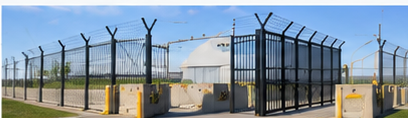
Praesidium identifies and develops designed interruption points where adversary movement can be predictably challenged and armed responders can engage from tactically advantageous positions. Barrier delay, adversary pathways, response timelines, fields of fire, responder access, and available cover are considered together when establishing these locations. Interruption points are positioned to provide responders sufficient time and tactical advantage to prevent adversaries from successfully reaching or completing actions against protected target sets.
Designed interruption points convert available delay into deliberate opportunities for effective adversary engagement.
02
FORCE
PROTECTION
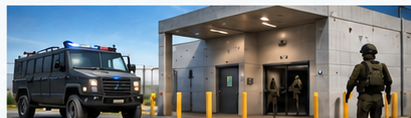
Responder effectiveness depends upon the ability of security personnel to survive, maneuver, communicate, and engage throughout the event. Praesidium evaluates blast- and ballistic-protected response facilities, hardened fighting positions, protected observation and engagement locations, and mobile protective barriers as elements of the overall protective strategy. Force-protection measures are integrated with responder deployment and tactical positioning so that personnel remain capable of performing their assigned security functions while minimizing unnecessary exposure to adversary fire or other hazards.
Protecting the response force preserves the personnel and capabilities necessary to sustain the defensive mission.
03
CHOKE
POINTS
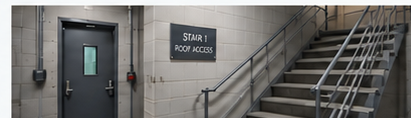
Facility configuration can be deliberately leveraged to constrain adversary movement. Praesidium evaluates building walls, corridors, hallways, stairwells, doors, access points, and other physical features to identify routes an adversary must traverse to reach protected target sets. These naturally constrained pathways can concentrate adversary movement into predictable locations where delay measures, surveillance, tactical positioning, and responder engagement can be most effective. When incorporated into the protective strategy, the facility itself becomes an active component of adversary denial.
Choke points transform facility geometry into tactical advantage by making adversary movement more predictable and controllable.
04
STAFFING &
DEPLOYMENT
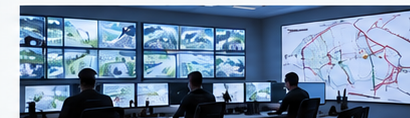
Protective strategies must be executable by the personnel available to implement them. Praesidium evaluates armed responder staffing, specialized weapons and equipment, pre-designated response positions, deployment timelines, communications, and command-and-control requirements when developing the response concept. Roles and responsibilities are structured to reduce unnecessary complexity and allow responders to rapidly transition from detection and assessment to deployment and engagement. Simplified command and control helps maintain coordinated action as conditions evolve.
Effective staffing aligns personnel, equipment, positioning, and command and control with the tactical demands of the protective strategy.